
The Backrooms Review: A24's Psychological Horror Masterpiece Explores the Terror of Liminal Space
June 4, 2026
By Matty Haze
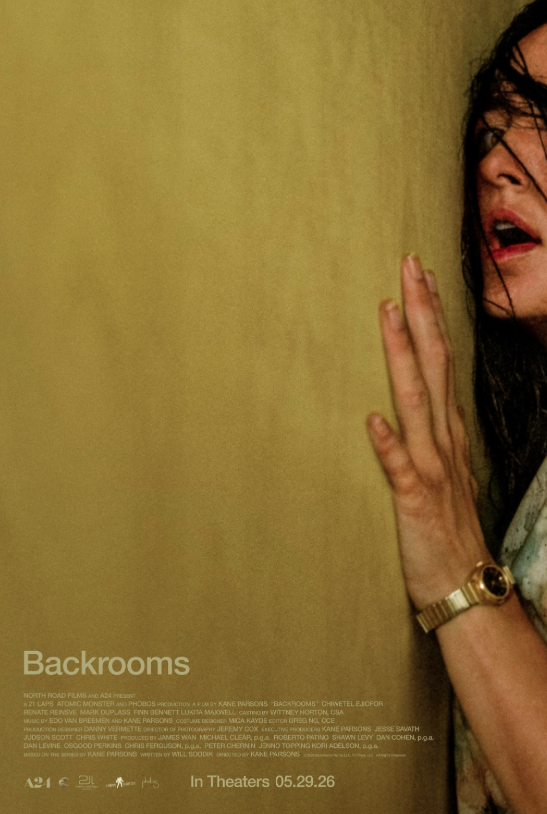
Genre: Psychological Horror / Sci-Fi / Analogue Horror / Found Footage
Step into the stillness
Imagine walking home from a gathering that stretched deep into the dead of night. As you turn onto your usual street, an unnatural quiet settles over the concrete. There isn't a soul in sight. A few distant streetlights hum, casting a weak, static glow. The parked cars, the rows of houses, the familiar storefronts, they all look exactly as they always do, yet everything feels entirely alien. When you turn around to look back, the path behind you has vanished, swallowed by an endless, creeping fog. You wander for hours, aimlessly drifting down streets that repeat in an impossible loop.
Discomfort and claustrophobia begin to tighten around your chest. Deep down, you know there is no physical predator actively hunting you, but the total absence of life in a space built for crowds is profoundly deafening. It is a suffocating desolation that feels fundamentally wrong, yet strangely, intimately nostalgic.
This is the psychological realm of the liminal space. It defines those transitional, eerie environments, places that once thrummed with human activity, now left vacant, carrying only the ghosts of memories and history. To be trapped inside a liminal space is to confront ahaunting paradox: a deep, visceral discomfort intertwined with a bittersweet yearning for a past you may or may not have actually lived. Over the last decade, this surreal aesthetic trend blossomed into a massive internet phenomenon, serving as the foundational bedrock for a new era of digital storytelling known as analogue horror and creepypastas.
The digital landscape remains chock-full of independent creators willing to lend their distinct ideas to make this eerie aesthetic grow, each adding their own unsettling spin to the collective lore. Among these, the most famous and culturally impactful is the found-footage phenomenon known simply as The Backrooms. Originally sparked by a viral video crafted by a then-14-year-old prodigy named Kane Parsons under his YouTube moniker, Kane Pixels, this innovative form of horror helped spawn an entire genre of atmospheric dread. People all over the web have since contributed their own expanded lore, crafting intricate webs of levels, survival rules, and anomalous inhabitants. Now, with Parsons making his monumental first venture into traditional cinema, stepping up as the world’s youngest feature-film director at the age of 20 under the prestigious A24 banner, a crucial question emerges: does this viral online nightmare translate well to the grand scale of the big screen?
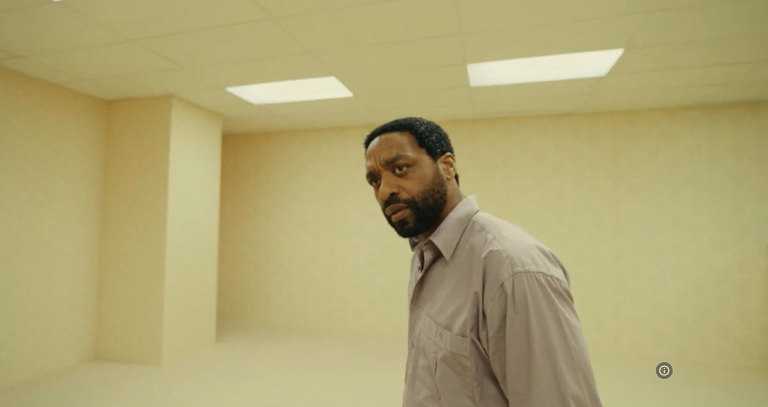
Chiwetel Ejiofor as Clark
When a broken life slips through a broken wall.
The cinematic adaptation of The Backrooms anchors its reality through the tragic, grounded story of Clark, portrayed with magnificent vulnerability by Academy Award nominee Chiwetel Ejiofor (12 Years a Slave, Doctor Strange). Clark is a failed architect whose grand creative ambitions have dissolved into the mundane reality of owning a struggling discount furniture store, the ironically named Ottoman Empire. Feeling utterly trapped in a suffocating, dead-end existence, he seeks therapeutic guidance from a psychiatrist, Dr. Mary Kline, played by Cannes winner Renate Reinsve (The Worst Person in the World). True to the melancholic tone of the film, Mary is an empathetic professional who is no stranger to her own deeply troubled past and unresolved emotional baggage.
During an intense therapy session, Clark lays bare his profound personal failures, revealing that he was recently kicked out of his home by his ex-wife, a humiliation that has forced him to secretly live within the warehouse walls of his own furniture store. The boundary between sanity and nightmare shatters late one evening. While inspecting the dark, deep recesses of his basement inventory, Clark discovers a strange, shimmering anomaly in a hidden partition of the wall. With a terrifying ease, he phases directly through the solid structure, no-clipping out of reality entirely, and wakes up on the other side. He awakens within an endless, labyrinthine complex of damp yellow rooms, fluorescent hums, and unmapped corridors. What follows next is a cinematic descent that is nothing short of deeply surreal and profoundly unsettling. A24 managed to secure an exceptionally notable ensemble of talents to ensure the film feels like a prestige psychological drama rather than a cheap jump-scare fest.
Chiwetel Ejiofor delivers an amazing performance as Clark, perfectly embodying a bitter, disillusioned man down on his luck who habitually blames everyone around him for his stagnation. Renate Reinsve matches his intensity beautifully, doing an incredible job portraying a supportive anchor who must simultaneously navigate the fractures in her own psyche. Rounding out the primary cast is Mark Duplass (Creep, Safety Not Guaranteed) as Phil, an enigmatic scientist operating under the banner of a mysterious, bureaucratic organization researching the anomaly. Duplass injects a chilling, calm pragmatism into the narrative, serving as a brilliant foil to the raw, human panic of the civilian characters.

It looks real. It feels wrong. Welcome to the infinite maze.
At its core, The Backrooms masterfully weaponizes the psychological phenomenon of the u canny valley, a state of mind where an object or environment feels fundamentally wrong despite its superficial familiarity. The film thrives on this cognitive dissonance. What appears to be nothing more than a mundane, corporate office interior is warped into an infinite, claustrophobic maze of vacant corridors and shifting halls that can lead an explorer anywhere, or nowhere at all. The ever-present threat of dangerous, unknown entities lurking deep within the architecture keeps the tension high, but the true terror comes from the silence. The film features a heavy, constant ambient hum, an eerie drone of fluorescent lighting that is as overwhelmingly suffocating as any loud jump scare could ever hope to be.
The physical production design of the film is a breathtaking, one-to-one recreation of the original web series. Kane Parsons, collaborating alongside talented production designer Danny Vermette, did a wonderful job capturing the vast, empty scale of the internet lore. By building massive, physical walls and winding hallways from scratch on soundstages, they give the environment a tactile, concrete weight. It looks like a real, physical location you could stumble into tomorrow.
This grounded realism honors the origins of the mythos; the iconic imagery of the Backrooms was originally born from a real-life, anonymous photograph of an old, empty retail space which was posted onto online forums years ago. While Kane Parsons was technically late to the internet trend, as he was far from the first person to write a story or upload a video about the lore, he was the very first creator to inject a breathtakingly realistic, photorealistic visual style into the mythos using digital software, a breakthrough that permanently cemented his digital fame and caught Hollywood's attention.
The void’s emptiness creates a surreal, dreamlike environment that rapidly curdles into a living nightmare the further our protagonists venture. To capture this descent, the cinematography brilliantly juggles traditional third-person narrative perspectives with frantic, first-person found-footage angles. The cinematic camerawork really sells the staggering, impossible scale of the labyrinth, emphasizing just how small and insignificant these human characters are against the endless yellow walls.
The sequences shot on simulated camcorders are easily the most deeply unsettling and terrifying moments in the entire film. By shifting the perspective to a raw, handheld lens, the movie forces you to feel as though you are the one trapped inside the yellow wallpapered maze. The horror here is incredibly effective because it relies on patience and spatial awareness; the dread built during these found-footage segments is designed to linger, guaranteeing it will stay with you long after the theater lights come up.
Renate Reinsve
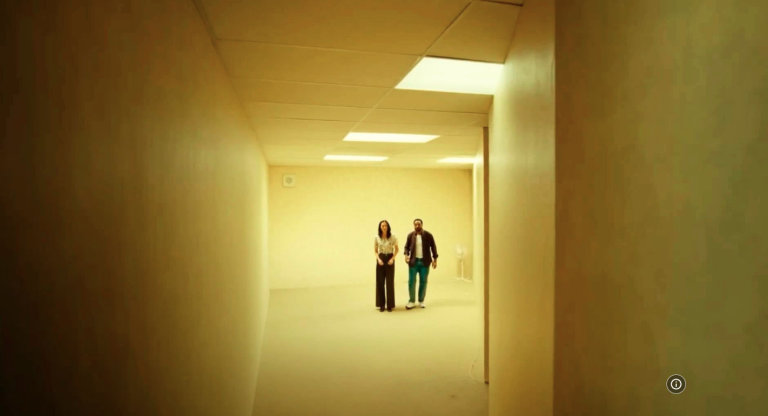
The Ultimate House of Mirrors: Where your past becomes your prison.
While the original thematic focus of the internet web series centered on human foolishness and the hubris of trying to conquer an infinite, hostile void, the feature film pivots toward something much deeper, darker, and more intimately psychological. The themes of the movie interpret the Backrooms not merely as a supernatural physical anomaly, but as a cosmic mirror that actively copies and distorts the psyches of the people wandering its halls. The labyrinth harvests pieces of the characters' pasts, attempting to recreate their memories in physical form, but it fundamentally lacks the human soul required to make a perfect copy.
The film beautifully illustrates this concept through a chilling analogy about a dog: if you try to explain the physical appearance of a dog to someone who has never seen an animal in theirmlife, they will attempt to draw it based strictly on what they heard. The final sketch will inevitably look monstrous, a twisted approximation of reality. This is exactly how the Backrooms constructs its world.
When analyzing the characters, this thematic mirror reflects Clark's deep-seated emotional stagnation and unfulfilled dreams. Because Clark refuses to grow as a person, consistently projecting blame onto his ex-wife and former colleagues for his broken career and failed marriage, the maze punishes him with physical architecture that embodies his paralysis. He is forced to confront imperfect, decaying copies of his old furniture store, distorted replicas of the inhabitants he once knew, and uncanny rooms that mock the domestic life he lost.
Similarly, the film invokes a profound sense of claustrophobic loneliness that directly mirrors the childhood trauma of his therapist, Mary. The Backrooms weaponizes her vulnerability bymanifesting hollow, warped configurations of her childhood home and abandoned furniture within the yellow depths. The maze becomes a literal, physical manifestation of their internal damage, turning their worst memories into an inescapable prison.
A masterful nightmare with a messy map.
In terms of execution, the pacing of The Backrooms sits somewhere in the middle of the spectrum. It moves deliberately, refusing to rush through the opening act so that the audiencen has ample time to intimately understand the psychological baselines of Clark and Mary.
However, despite this strong character foundation, the film's structural flaws do occasionally show through the drywall. The narrative keeps its focus so tight on Clark and Mary that the supporting cast suffers as a consequence. Intriguing characters, particularly Phil and the scientists working for the shadowy research organization, are present in the script but are ultimately left unfleshed out, leaving their motivations and lore feeling frustratingly underbaked.
Furthermore, the film suffers slightly from a conservative distribution of its best asset: the terrifying found-footage sequences. What few found-footage segments we are given are bone-chillingly excellent, but the final cut would have benefited immensely from a few more of these high-tension, first-person sequences to break up the slower, dialogue-heavy dramatic stretches in the second act.
Finally, the editing stumbles when it comes to communicating the passage of time. As the characters journey deeper into the maze and the scenes transition, the visual and narrative indicators of time intervals are far too subtle to notice. This lack of clarity becomes particularly jarring during the frantic final act of the movie, leaving the audience occasionally confused about whether hours, days, or weeks have passed between specific narrative shifts.
The future of horror is yellow, empty, and infinite.
Ultimately, The Backrooms represents an exciting, revolutionary shift in the modern media landscape, a new kind of cultural phenomenon where independent digital creators can successfully leap from YouTube straight into the director's chair of a major Hollywood production. Despite its noticeable pacing flaws and narrative bumps, what Kane Parsons has delivered is an incredibly promising, highly creative cinematic debut. It is a testament to his vision that a film born from a forum post can feel this special, delivering a surreal, deeply disturbing dreamscape where the past and human memory take form in the most uncanny ways imaginable.
With A24 heavily backing the project and early rumors of a sequel already circulating, it is clear that this universe has plenty of room left to expand. The movie is virtually guaranteed to reach a massive cult-classic status within the horror community in a few short years, thanks to its bold willingness to prioritize psychological atmosphere over cheap, predictable tropes.
If you are a cinephile who enjoys horror with a deeper psychological meaning, or if you are dedicated fan of internet lore, creepypastas, the SCP Foundation, and analogue horror, then this film is a mandatory watch. Step inside, embrace the hum, and witness the best claustrophobic nightmare of the decade.
Final Verdict: 4/5 Stars
The Backroom is now showing in cinemas nationwide.
Photos courtesy of IMDb.
About the Author
Matty is one of the correspondents and writers of Together Manila. He documents the new and noteworthy, one review at a time. Whether he is sinking into a theater seat, losing himself in an orchestra swell, or getting swept away by an anime binge, he is always chasing the next great story. Gaming, listening to music, and helping promote events keep him busy between deadlines. Aesthetically, he lives in a dreamy space between space core (vast galaxies and drifting satellites) and Frutiger Aero's glossy, hopeful futurism.